Discussion Paper – Getting Major Projects Built in Canada, There is a Better Way

The Government of Canada has published a sparse but alarming Discussion Paper that proposes sweeping reforms to federal assessment and permitting processes. The overall goal of the Paper is to simplify and shorten these processes so that major projects can be approved and implemented more quickly. The public consultation period on the Discussion Paper has been extended until July 22, 2026. I have reviewed submissions by the Canadian Environmental Law Association, 350.org and Environmental Defence. All three have grave concerns about what the government is proposing to do. Here is a nutshell summary of what the Discussion Paper proposes:

  • Arbitrarily compress all federal decision-making for major projects into an one-year timeline, without specifying which types of “major projects” will receive this preferential treatment
  • Wholly exempt major projects regulated by the Canadian Energy Regulator (i.e. international/interprovincial pipelines and electricity transmission lines) from the current legal requirement to undergo rigorous impact assessments under the Impact Assessment Act (IAA)
  • Empower the Canadian Nuclear Safety Commission (CNSC) to conduct impact assessments of nuclear and uranium projects under the IAA, and to determine whether such projects would cause significant negative federal effects. This would effectively sideline the Impact Assessment Act for these types of projects, relying instead on the CNSC to carry out robust, credible, and participatory impact assessments of nuclear projects, and make final determinations about whether such projects may cause significant adverse effects that cannot be mitigated.
  • Enact new legislation to establish “Federal Economic Zones” through regional assessments which would oust the requirement for project-level assessments for a broad range of “pre-approved” infrastructure and industrial development in such zones
  • Eviscerate current federal permitting regimes in relation to navigation, ocean dumping, fish and fish habitat, and exempt major projects from the critically important provision in the Species at Risk Act which prohibits the federal Minister from issuing permits for activities that may jeopardize the survival or recovery of species at risk (i.e. orcas)
  • Allow unspecified early construction activities for major projects to occur well before an impact assessment decision has been made to approve or reject the project.

The BEA Board approved the following position statement in response to the Government of Canada’s proposal.

My name is David Laing. I am 74 years old and have been living in Brampton Ontario for close to 50 years. I am also the President of the Brampton Environmental Alliance, and I am writing this submission both on my own behalf as well as that of the Alliance. After reviewing the “Getting Major Projects Built in Canada” discussion paper I have grave concerns about the direction being taken by the Government of Canada as outlined therein.

I have lived long enough to experience a time before there were robust environmental protection regulations in Canada, particularly in Ontario, when Lake Erie was considered to be a “dead lake” with no oxygen to support aquatic life, when Lake Ontario was so polluted that water activities such as swimming and paddleboarding in the Lake were considered unthinkable, when toxic effluent floating on the Don River was so concentrated that it actually caught fire on more than one occasion. If enacted, I fear that the proposals in this discussion paper will be taking us back to those times, of the environmental wild west in the name of economic growth. Surely there must be a better way for Canadians to address the threats to our national sovereignty than to destroy the very essence of what makes Canada great.

The purpose of having environmental regulations is to allow governments to make challenging decisions about which parts of our environment should be saved or destroyed based on scientific evidence and expert analysis. Their purpose shouldn’t be to merely slow down project implementation but to decide if a project should proceed or not. That analysis may take a year, or it may take 10 depending on project complexity and how much is known about the impact on affected eco-systems. Some projects simply shouldn’t be built because of the level of damage they will cause, no matter how much economic growth potential they promise. Do we really want to put the fate of Canada’s natural heritage assets in the hands of politicians who are almost always driven by 4- or 5-year election cycles and are prone to populist pressures? We think not.

Making decisions that cause environmental destruction must be carried out with the utmost care and with as much knowledge as possible. The stakes are very high, and the likelihood of “unintended consequences” is significant. We must be conscious of the fact that, once an ecosystem is destroyed, it is gone for decades, once a species is extinct, it is gone forever.

For environmental regulations to be truly effective, they must act more like a constitutional framework, representing the fundamental values of the country and its citizens. Support for the environment cannot be viewed as a “fashion statement”, in favour today, and out of favour tomorrow or next year. We must find out from Canadians what aspects of Canada they hold truly dear. The unique aspects of this country, such as the Salish Sea Orca, the rich aquatic eco-systems of the Douglas Channel and the eco-system services provided by the peat bogs of Northern Ontario, to name but a few. Only then can we truly know what should be saved and what can be sacrificed in the name of economic growth.

Accordingly, the BEA supports CELA’s position that being to, “immediately withdraw the ill-conceived Discussion Paper proposals which, if implemented, would constitute the most significant rollback of federal environmental laws in recent decades”. Like CELA, members of the BEA do not oppose economic activity, good jobs, or sustainable resource management.

As inspiration, I recommend that the Government look to the Haida Nation with the sustainable practices they have implemented with their vast wealth of forest, fish, and minerals, and the excellent relationships they have established with the B.C. Government as well as the various extraction industries. The Haida have managed to find that delicate balance, where the environment and the economy support each other helping to ensure the health of current and future generations by not repeating the mistakes of the past. I believe that most Canadians want what we want, economic prosperity in the context of strong(er) environmental protections, ensuring that, what we hold dear about Canada, will last forever.

David Laing – President, Brampton Environmental Alliance

https://bramptonea.org 416-402-3778

Brampton Climate Walk & Native Plant Tour at Dorchester Park

Hosted by Brampton Environmental Alliance in collaboration with Toronto Climate Week
Sunday June 7, 2026 | 12:00 PM – 1:00 PM Dorchester Park, Brampton (Meeting point details will be confirmed upon registration)

What if your front yard, backyard, or boulevard could become a haven for bees, butterflies, and the plants that sustain them — right here in Brampton?

Continue reading “Brampton Climate Walk & Native Plant Tour at Dorchester Park”

BEA partners with Plant Powered for the Earth to bring an exciting Pollinator Habitat workshop and program to WG Davis SPS.

Pollinators are essential to healthy ecosystems, food production, biodiversity, and climate resilience across Ontario. Creating pollinator gardens with native plants and installing bee hotels are simple but powerful ways communities can support declining native bee populations while helping mitigate climate change through healthier urban ecosystems.

Recently, Brampton Environmental Alliance partnered with Plant Powered for the Earth to bring a Bee Habitat Program called “ Pollinator Habitat Protectors” to W.G. Davis Senior Public School. Students participated in a hands-on seminar and workshop about the importance of native plants and pollinators, and decorated six bee hotels built and provided to the school by both organizations to help enhance the school’s pollinator garden and provide a habitat for solitary bee pollinators.

The workshop was facilitated by environmental educator Yarim Hinojosa to the school’s grade 7 students and Eco Club. The goal was to inspire and empower the students by teaching them all about native pollinators and pollinator-loving plants of Ontario, how to protect pollinators and their habitats and the advantages of bee hotels.

The workshop had the indigenous perspective or approach called “two-eyed seeing” (Etuaptmumk) as a guiding principle. Mi’kmaq Elder Albert Marshal originally introduced this approach and it advocates for looking at the world with one eye using the strengths of Indigenous knowledge and ways of knowing, and with the other eye using the strengths of Western knowledge and methods. We used this approach to help the students better understand the importance of native pollinator animals and native plants in Ontario.

One example that was shared was the indigenous perspective of reciprocity and connection between plants and bees proposed by Robin Wall Kimmerer, who is a plant scientist, poet, member of the Potawatomi Nation, mother, and student of Native American stories and traditions.

In her book Braiding Sweetgrass: Indigenous Wisdom, Scientific Knowledge, and the Teachings of Plants, Robin Wall Kimmerer says “while beauty may be in the eye of the beholder, she says, science also tells us that the two colors of purple asters and yellow goldenrod, having reciprocal colors in human and bee eyes and growing together, attract a greater number of pollinators than either would growing alone, therefore leading to better plant success.”

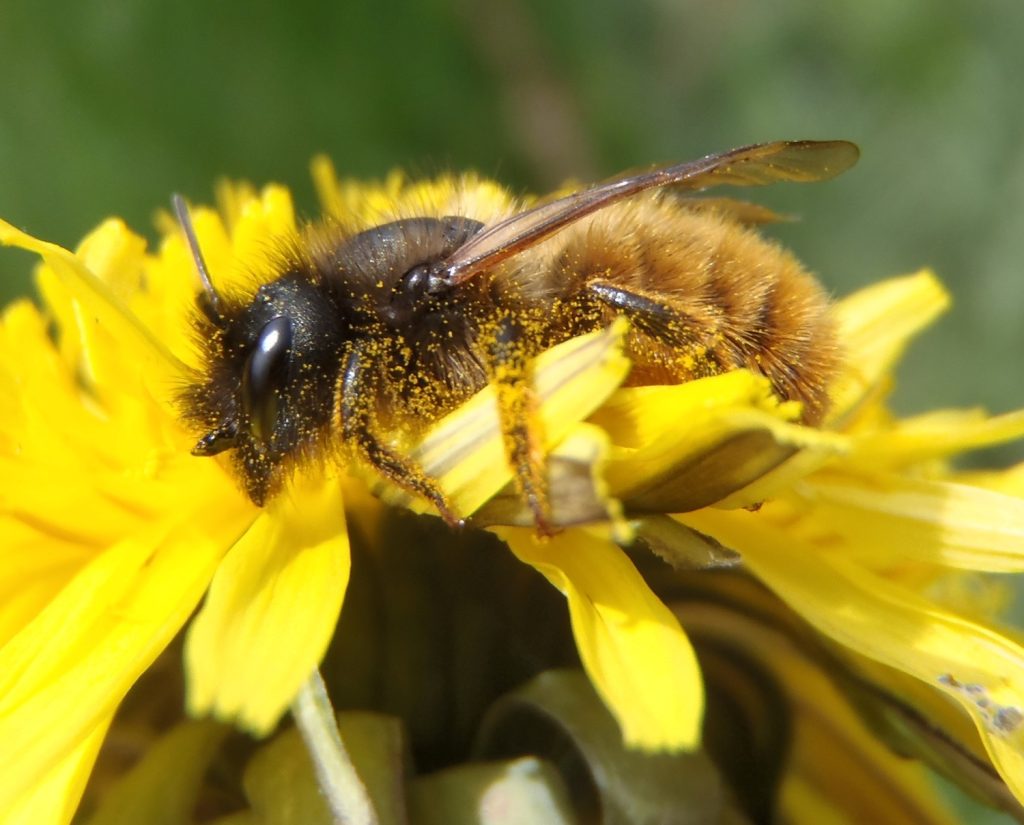
The students learned about botany, biology and ecology, as well as how to identify and grow native plants that attract native bees and butterfly pollinator animals in Ontario. There was a special spotlight on the plants that will be grown in the school’s brand new pollinator garden. These plants include bee-attracting specimens like Smooth Blue Aster, Oxeye ( pictured above with a green female Sweat Bee), Pearly Everlasting, Mountain Mint, Lanceleaf Coreopsis, Blue Lobelia among others.

The students also learned about the botany and ecology of butterfly-attracting plants like Wild Columbine, Purple Coneflower, Cardinal Flower, Butterfly Milkweed (Pictured above with a Monarch Butterfly), Hairy Beardtongue, Dense Blazing Star, Dense Blazing Star, Smooth Blue Aster, among others.

Did you know? Milkweeds are larval host plants for monarchs, which are a native species to Ontario. Increased plantings of these wildflowers will help populations of these regal butterflies in their efforts to make their grand migrations, a phenomenon which is in peril.

The students also learned about the challenges that native bee species face in Ontario, such as pesticide use, destruction of habitat and competition with non native species and actionable ways to help.

Did you know? A study by the University of Toronto suggests that non native species, including honey bees, which are an introduced species, are affecting Ontario’s native solitary Mason bee population.

The students were amazed to learn about the ecology of native solitary bee species, which many had never seen or heard about. This is not surprising as most media, illustrations and advertising portray bees mostly as “honey bee-looking”. They quickly became aware of the importance of learning about the various kinds of native bees in Ontario to protect them. Some of these beautiful, solitary species native to Ontario include those in the Osmia genus (Typical Mason Bees / Orchard Bees) and the Megachile genus (Leaf-cutter bees )

Osmia lignaria (Blue Orchard Mason Bee) – The most well-known native mason bee, metallic blue-black, and a highly efficient early-spring pollinator.

Megachile latimanus: A large, widely distributed, and extremely common leafcutter species.

Native bees face many challenges, but part of the solution, besides awareness and education, is protecting and providing habitat. The ideal habitat is a natural habitat, in urban areas, without pollinator gardens or plants; the students learned that humans can offer shelters or structures like bee hotels.

Everyone in attendance was inspired to plant more native plants in their homes, balconies, and communities that attract pollinators. We also showed them the benefits of providing solitary bees a “bee hotel” as habitat for their pollinator garden, which will provide native solitary bees a home near the school’s pollinator garden.

The workshop ended by having the students paint the outside of six bee hotels with colors which bees are attracted the most such as blue and yellow. These bee hotels were designed and built as a collaboration by the BEA and Plant Powered for the Earth, and donated to the school to enhance their pollinator garden.

The students also shared what they learned, and everyone expressed genuine interest, shared responsibility and excitement to help protect pollinators and native plants in their school and monitor the lifecycle of bees visiting their bee hotels.

The workshop and program will include ongoing monitoring by the BEA and Plant Powered for the Earth in collaboration with WG Davis SS of the bee hotels and their full lifecycle. The goal is to introduce students to hands-on environmental education and citizen science while helping support native solitary bee populations, encouraging the planting of pollinator gardens for biodiversity, food security and to mitigate the impact of climate change in Brampton.

Programs like this help advance local pollinator habitat goals, encourage the planting of native gardens, strengthen biodiversity, and contribute to climate action by creating greener, more sustainable communities.

If schools, organizations, or community groups are interested in bringing this Bee Habitat Program to their school or institution, please contact us, we would love to collaborate.

info@bramptonea.org

contact@plantpoweredfortheearth.org

Ever wondered how discarded packaging in the Blue Box becomes new packaging?

Most of us put something into the blue box every week and hope it gets recycled properly. Have you ever wondered what actually happens behind the scenes after the truck picks it up? How much of it actually gets recycled? Or, why materials need to be separated into the blue, black or green bins?

These are important questions that our BEA team is aiming to answer at an upcoming interactive workshop on Thursday, June 04, 2026. There you will learn why it is important to separate your waste, how to dispose of it in a way that has the least environmental impact, and how discarded material, like an old yogurt container, eventually become new packaging again.

Continue reading “Ever wondered how discarded packaging in the Blue Box becomes new packaging?”

BEA Partners with Brampton Forestry, ACER and local schools to deliver tree monitoring

The BEA has partnered with Brampton Forestry and the Association of Canadian Educational Resources, (ACER) to provide tree monitoring services to sites at Batsman and Gore Meadows Parks. Students from Louise Arbour and Fletcher’s Meadows Secondary Schools participated in the 2-day event, Batsman Park on May 02nd and Gore Meadows Park on May 16th.

After introductions I started each session by explaining the ecosystem services that trees provide. Trees help to keep our cities cool during increasingly hot summer months. They absorb carbon dioxide and release oxygen that all animals, including humans, need to breathe. They help to slow down winter winds keeping our cities warmer during the colder months. They provide habitat for urban wildlife, And, finally trees are beautiful to look at. They provide city – dwellers an opportunity to engage with nature which has been shown to improve both physical and mental health.

Alice Casselman, ACER’s President instructed students on the use of tools used to measure tree height, trunk diameter and the volume of the tree crown, (the area covered by branches and leaves). The students also learned to identify tree species, and common diseases affecting tree health. They received instruction on proper mulching techniques to ensure that the ground around the tree trunk stays moist while preventing trunk mold growth and protecting delicate roots.

The students then went out to the planting areas to perform the measurement tasks, record the results on their data sheets, and spread city provided mulch around each tree as required.

Over 100 trees were measured over the two days and over 200 trees received mulch.

Brampton’s Forestry Department will receive the collected data and use it to help inform the city’s urban forest management plan.

It seems a good time was had by all.

Announcing the ClimateFast Brampton Voting Record Database

ClimateFast

The Brampton Environmental Alliance is pleased to announce a collaboration with ClimateFast to bring climate accountability and transparency to the City of Brampton. ClimateFast is a volunteer-led not-for-profit organization driving climate action through education and civic engagment. Now, through the Brampton Environmental Alliance website, you can access a searchable database of votes made by Brampton City Council on climate and environmental issues during this 2022-2026 term. With this database we can now see how our Council stacks up on climate leadership.

Continue reading “Announcing the ClimateFast Brampton Voting Record Database”

My trip to the Netherlands

I just returned from a 2-week bike and boat tour in the Netherlands. It was a transformative experience, seeing first-hand how a society and economy can be built where the car is not the primary mode of transport, where most energy requirements are met by renewable sources, and where climate action is a visible and normalized part of daily life.

De Nassau ship, part of Boat and Bike fleet
De Nassau ship, part of Boat and Bike fleet. This is the ship we sailed on. Bikes were unloaded onto the dock in the morning. We rode to the next town where the boat would meet us in the evening. Breakfast and dinners were served on the boat and we packed lunches each day to take with us. Photo credit: Boat and Bike
Continue reading “My trip to the Netherlands”

TRCA Announces Climate Ready Homes Program

Climate Ready Homes

This past week I met with Sarah MacKell, from TRCA. Sarah is a Program Manager with the Sustainable Neighbourhoods Action Program (SNAP). You can read about the activities that the BEA has done with the Bramalea SNAP team over the past several years here.

Sarah was telling me about the Climate Ready Homes program that TRCA started in September 2025. The program builds on the success of SNAP. Climate Ready Homes is designed to help homeowners make practical, affordable upgrades that boost comfort, save money, and prepare for a changing climate. It provides access to personalized guidance, financial incentives and educational workshops on a variety of topics including:

Continue reading “TRCA Announces Climate Ready Homes Program”

BEA hosts most successful AGM in its history!

Over 100 people, aged 11 to 80, from all different walks of Brampton life, attended the Brampton Environmental Alliance Annual General Meeting this past Monday March 02nd. Co-hosted by BEA Board members Amisha Moorjani and Gunjan Sharda, the meeting took place at the Unifor Local 1285 Hall, where the group was warmly welcomed by Local 1285 President, Vito Beato following the land acknowledgement delivered by BEA Board member Yarim Hinojosa.

Continue reading “BEA hosts most successful AGM in its history!”

Brampton Council punches hole in east-west cycling corridor

Cyclist on Howden bike lane

This past week Brampton Council voted 10-1 in favour of removing the bike lanes along a section of Howden Blvd. between Williams and Dixie. Councillor Santos was the only member who upheld Vision 2040 and the principles of good city building. There is no candy-coating this; it is a huge blow to the city’s plans for sustainable transportation.

Continue reading “Brampton Council punches hole in east-west cycling corridor”