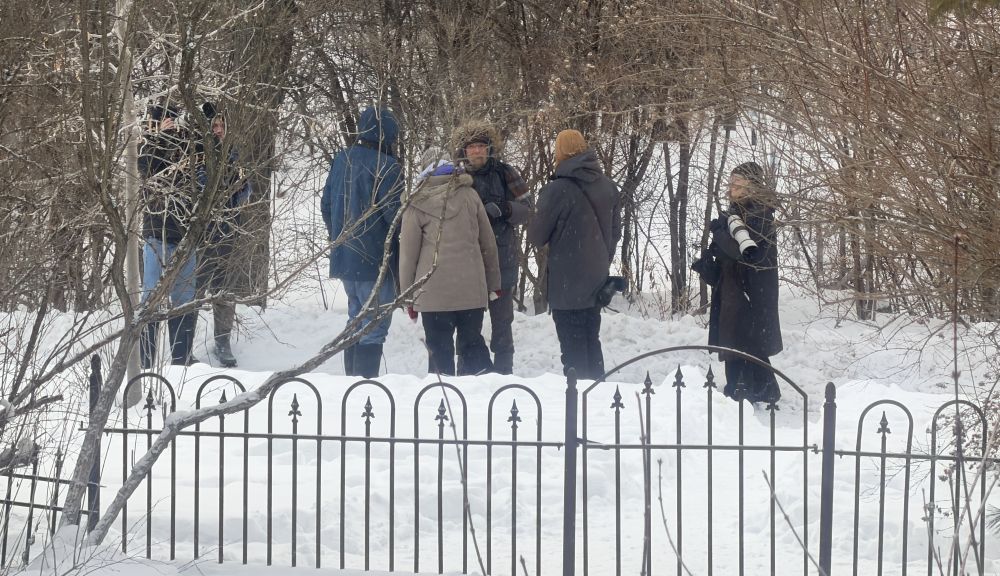
Who knew that one little bird, the size of a sparrow could create such a stir. It all started this past Wednesday when we looked out our kitchen window to see a woman, carrying a camera with a lens as long as a bus, taking pictures over our backyard fence. She wasn’t a stranger. We’d chatted with her often while on our twice daily walks, always carrying her camera, ready to take pictures of birds and animals that she saw along the way. But that day was different. She seemed very excited as she waved at us. Dayle went out on the deck to ask her what she was doing. It turns out she had sighted a Spotted Towhee, scratching for food under a forsythia bush in our yard.
The Spotted Towhee (Pipilo maculatus) is described as a large chunky New World sparrow. The male is recognizable by a black head, a black back with white spots, rusty-red sides and a white belly. They can be seen in thickets or bushy backyards hopping in the undergrowth and scratching for seeds or insects.
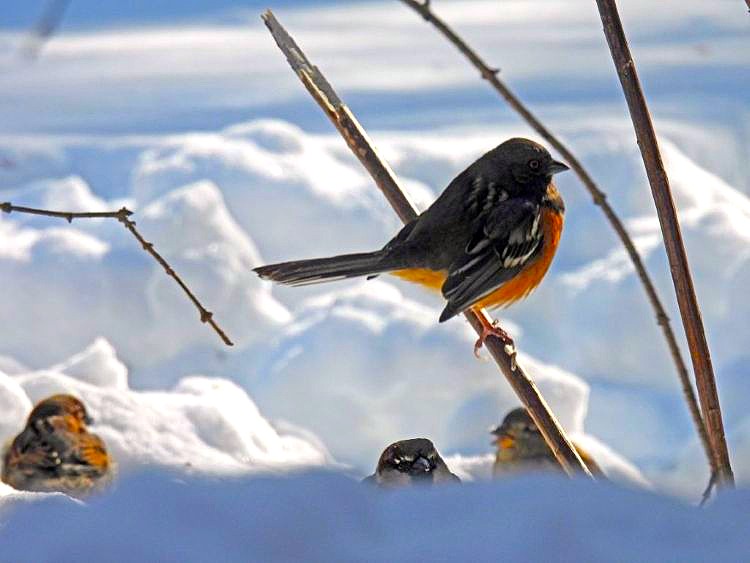
So what’s so special about this bird? Well they are commonly found along the west coast of Canada and the U.S. as well as the southern Canadian prairie. That means this Towhee in our backyard travelled more than 1,000 kilometres outside its normal range! According to our birder friend, the last time a spotted Towhee was “spotted” in southern Ontario was more than 12 years ago! Hence the excitement.
And word spread fast. Only a few hours later, the almost constant stream of human visitors started to come; more than 50 over the past 5 days, Ninety-nine percent were very respectful, staying at the edge of our property and trying not to point binoculars and long-range lenses directly into our windows. They were friendly and chatted with us as we passed by. Some came from as far away as Cambridge, Orillia, and Vaughan.
We wondered how this little bird could end up so far away from its normal territory. If only it could talk! When birds stray from their normal ranges, a phenomenon referred to as vagrancy, it could be because of navigation error, or environmental factors. Land use practices and wildfires are ravaging the shrubby habitats, and forest edges where the Towhee typically thrives. Perhaps this little guy is a pioneer, looking for a new area to set up home. Or perhaps he was caught in a major storm that blew him “off course” during migration. A birder who seemed knowledgeable said it could have taken four months or more to travel this far. Perhaps it was a combination of wind and wildfire smoke that this bird found disorienting. Regardless of the reason, we are happy he survived and that he has found a little haven in the messy undergrowth of our backyard!