[Updated version March 22, 2023 correcting statements made regarding historical landowner compensation]
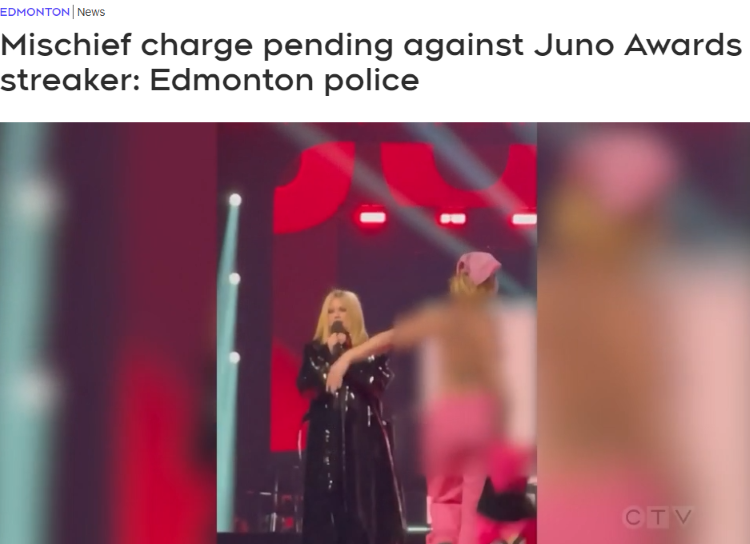
The topless streaker at Sunday March 12th’s Juno awards ceremonies garnered more news attention for the potty-mouthed reaction from music award presenter Avril Lavigne than it did to the messages the streaker displayed on her body, “Land-back” and “Save the Greenbelt”. That’s unfortunate. We need more adult conversations about how we are using the precious land resources contained within our borders, including and maybe especially the, (as yet), undeveloped land that surrounds our major Canadian cities.
The Brampton Environmental Alliance is pleased to announce that it has received grant funding from Employment and Social Development Canada to implement a “New Horizons for Seniors” project called, “Graceful Aging Through Connecting With Nature”.
Brampton has been all over the news in the last two days because a family of coyotes have chosen a school yard as a place to hang out. Recent sightings on the property of Our Lady of Peace Separate School prompted staff to keep students inside during recess over the past few days. Concerned parents are asking the City to remove the coyotes by trapping or culling as they fear the coyotes present a threat to their children’s safety. While somewhat understandable, this reaction is unfortunate and the action called for would likely be ineffective.
Last Thursday evening the BEA was invited to participate in the Peel Talks Climate event sponsored by the David Suzuki Foundation. The event was held at Alderlea, a heritage conference building in downtown Brampton.
A MODEL FOR ENVIRONMENTAL SUSTAINABILITY AND ECONOMIC STABILITY
Managing Without Growth – Second Edition
The relationship between the natural world and the “progress of humanity” has been complicated and contentious ever since man invented tools and fire. The human brain and psyche have allowed us to out compete most other living organisms. We have developed a model that measures progress based almost exclusively on economic growth.
For centuries our ingenuity and the application of technology have allowed human populations to continue growing at increasing levels of prosperity, consuming resources and producing waste while skirting the limits of a finite world.
How long can we continue dancing on the edge of the cliff and not fall into the abyss? We now affect, what some would argue, is an outsized portion of the world’s resources compared to our population. Example, our species is throwing so much carbon into the atmosphere that it is affecting the climate, threatening our very existence as well as the natural world around us.
Is there a better way? Is there a different model based on something other than Gross Domestic Product (GDP) that would allow us to live in relative comfort while maintaining a sustainable relationship with the world that surrounds us and nurtures us? Smart people like Peter Victor think so.
Peter Victor is a Professor Emeritus in Environmental Studies at York University. His book, Managing Without Growth – Slower by Design Not Disaster, challenges the priority that rich countries continue to give to economic growth as an over-arching objective of economic policy. The challenge is based on: a critical analysis of the literature on environmental and resource limits to growth, the disconnect between higher income and happiness, and on the failure of economic growth to meet societal objectives of full employment, elimination of poverty and environmental protection.
Peter’s book uses a rigorous approach to provide insight at the frontier of ecological economics using both systems modelling and a more conventional macro-economic analysis. I encourage you to read the book but here is my précis. Summarized elements of Peter Victor’s economic model:
The Economy is a system which converts inputs (energy, material, land) into valued goods and services which contribute to individual well-being. Along the way, wastes are also produced as by-product. As the economy grows it consumes more inputs, generates more goods and services and creates more waste. The Economy is an open-ended system meaning that, theoretically, it could grow forever. It is responsible for neither creating the inputs nor for assimilating the wastes. For these things the Economy relies on the Environment. But the Environment is a closed system meaning that there is a finite limit on the amount of inputs it can supply and the amount of waste it can assimilate. As the Economy grows beyond the bio-physical limits to support it, economic output goes into precipitous decline.
Initially individual well-being improves as the economy grows. But, as economic growth continues the relationship between economic growth and improvement in well-being becomes less and less direct. What that means for most “western” economies is that economic growth is no longer contributing positively towards individual happiness.
In a traditional economy, economic throughput is essentially controlled by market prices. The economy assumes that all of the inputs are owned by somebody. If someone wishes to produce a good or service that requires an input (raw materials, labour etc.), a price for that input will be established with its owner. The scarcer the input, the higher the price. The higher the price, the more effort will be expended to create cheaper alternatives or discover ways to reduce consumption by making more efficient use of the input.
Many aspects of the environment are used by everyonebut owned by no one. Lack of ownership means no custodianship and scarcity in this context is not defined nor effectively measured. Market forces, therefore, are not good at setting prices for environmental qualities. Examples would be the atmospheric quality degradation as a result of the production of greenhouse gases or the bio-diversity reduction as a result of habitat destruction. There is not an entity that owns the atmosphere or that has custodianship of bio-diversity. Until recently, this didn’t matter so much as the natural cycles were able to accommodate and adjust to the environmental pressures caused by economic growth. Now the scale of the economy is so large that the natural cycles are being overloaded and have begun breaking down. A partial answer to this dilemma is to reduce the global rate of economic growth to near zero.
In Canada, a no-growth economy would still strive for the following: a. Full employment (defined at 4% unemployment or less) b. Poverty elimination (based on Statistics Canada Low Income Cut-Off model) c. 2% inflation or less managed by the Bank of Canada d. Environmental sustainability as measured by decreased GHG emissions that would sustain a 1.5°C increase or less to the global climate e. Declining debt to GDP ratio
The government policy elements that would move us in the direction of this low or no growth economic model would be: a. Balancing immigration levels, life expectancy and birth rate to achieve a stable (not growing) population base b. Management of the environment according to the three “Daly” principles, i.e. : i. The rate of consumption of renewable resources should not exceed their rate of regeneration, ii. The rate of depletion of non-renewable resources should not exceed the rate at which renewable alternatives are created, iii. The rate of waste emissions should not exceed the eco-system’s ability of to absorb it (For example, this implies setting a price on carbon emissions, either tax or cap and trade) c. Setting out a measures to combat social exclusion and poverty including: i. Macro-stabilization and framework measures, (e.g. framework legislation establishing rights and freedoms) ii. Protective measures aimed at maintaining a safety net, (e.g. targeted wealth transfers such as social assistance and social housing) iii. Measures to promote work incentives and support labour market entry and participation, (e.g. literacy, language and skills training) iv. Measures aimed at creating/expanding/maintaining economic opportunity, (e.g. job creation and support for self-employment) v. Measures to promote community based economies and neighbourhood quality, (e.g. community, social and economic development, local support for culture, sports and recreation) vi. Reformation of public programs for greater accessibility, (e.g. health, education and financial services access) vii. Measures promoting the quality of life, well-being and personal development, (e.g. investments in health programs and support for issues such as teen pregnancy, mental health, substance abuse) viii. Measures aimed at enhancing community receptivity, (e.g. anti-discrimination measures) d. Setting our measures to encourage work-week reduction to reduce individual “over-employment” (i.e. those working more than 50 hours/wk) and provide better work/life balance as well as creating more employment opportunity) e. Focus investment, productivity gains and technology development patterns in ways that support and reflect the changing direction in how people lead their lives: more leisure and recreation, more time with family, friends and community, more public goods, fewer private, status goods. f. Tax corporations based in part on the capital that they employ because it favours investment in people over produced assets g. Impose a structured capital gains tax that favours investment in beneficial, less damaging technologies h. Impose tax structures that favours maintenance and repair of, rather than replacement of, existing capital stock i. Implement limits on economic throughput that would translate productivity gains into increased leisure to reduce the rate of unemployment or to reductions in environmental burden through environmental training, awareness and changes to process j. Implement technology assessment programs that would review proposed implementation of new technologies to evaluate both their beneficial and deleterious effect in terms of achieving the goals that people really value k. When evaluating the benefits of international trade agreements, consider their environmental impact both in the source country and in the transport of raw materials and finished and semi-finished goods around the world. Aim for net zero balance of trade on a global basis. l. Impose policies to curtail the culture of consumption as a way to increase status at the expense of others. Instead, consumption should be focused on purchasing goods or services that are truly useful and on increasing individual well-being.
Caveats: a. Don’t expect very many of these policy initiatives to come from governments as they are now structured. As Peter Victor says, “they must be wanted and demanded by the public because they see a better future for themselves, their children and the children of others, if we turn away from the pursuit of unconstrained economic growth.” (hence the Fridays for Future movement) b. It is highly unlikely that a single country could move towards a no-growth economy on its own. It must be a global initiative, one which initially tolerates growth for the less developed countries at the expense of growth for the currently, “richer” nations c. While small community based initiatives will help initiate and support the groundswell, ultimately the change must migrate to the mainstream. Again to quote Peter Victor, “A ground swell of support for voluntary simplicity and for more locally based economies and communities, or something similar, might be just what is needed to lead the transformation that logic, data and compassion say is required, but it will not be sufficient. Unless governments introduce appropriate policies for managing without growth based on widespread support but obliging all of us to change our ways, the contributions of those willing to lead the way will prove insufficient.”
Peter Victor’s book was written in 2009 with an updated edition released in 2019. It’s concepts are even more relevant today than when the book was first released and the reasons for change ever more compelling.
The COVID – 19 pandemic has taught us global economic transformation is possible if the consequences of not taking action are seen as too dire. The catastrophes associated with climate change mount up by the day with untold human suffering and economic damages into the trillions of dollars. What will be the tipping point when collectively we say, “enough is enough. We need to try something different.”
Join us on Saturday August 27th for a free, fun, social, event to promote waste clean up and reduction. It’s all part of the Families of Virtue “Back 2 School BBQ”! We will be painting City of Brampton garbage cans by the numbers using designs provided by local artists. Our friends from Sierra Club Peel will also be demonstrating what gets recycled and what gets tossed through their waste sorting game.
Where: In the greenspace behind 4 & 10 Knightsbridge Road When: 12:00 pm to 5:00 pm.
Feeling helpless about environmental issues such as, noxious weeds, pollution, flooding and climate change? Consider joining the Brampton Environmental Alliance. We welcome both individuals and organizations. Come to our BEA members meeting at the BBQ on the 27th. It will run from 1:00 – 2:00pm. Learn who the BEA is and what we do. Learn about One-Planet Living. Meet our member organizations. Learn what you can do to advocate for the environment in your community. All are welcome. See you there!
ANTI-LITTERING WASTE EDUCATION CAMPAIGN organized by the Brampton Environmental Alliance and supported the Toronto and Region Conservation Authority
Excerpt from a paper written by the BEA’s York University Student Intern, Sapthasvanaa Killewalavan, (Saptha).
Through the 2040 Vision process and other outreach activities, Brampton residents indicated they want the city to be a leader in environmental innovation. They want our civic leaders to build a healthy, safe, and sustainable city.
Community resilience is fostered by helping connect people with nearby nature. We want people to value nature. Humans depend on forests and rivers for their well-being. We wish to help people understand human impacts on the built environment.
By: Rosemary Keenan, Sierra Club Peel Chapter Chair and David Laing, President, Brampton Environmental Alliance
Earth Day Activities
It was a brisk, enjoyable and energizing day at the first ever Grown Green Awards Celebration held at Norton Place Park this past Saturday April 23rd. Norton Place Park is a hidden gem in the heart of the City with a small lake beautifully surrounded by trees and trails. The Earth Day event was about celebrating the Brampton City’s and its residents contributions to a more environmentally friendly world.
Recent reports from the International Panel on Climate Change paint a grim future for our planet in the coming years unless we make dramatic changes in how we produce and consume energy. That scary analysis should be enough to mobilize us to take action. But what can we, as individuals, realistically do?
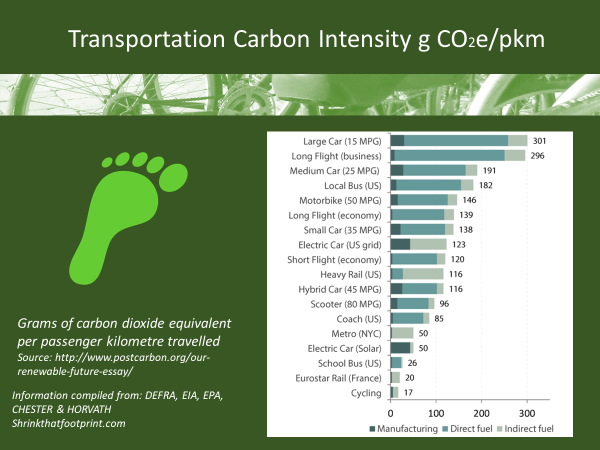
Carbon emissions are a waste by-product from our production and use of energy. We can lower emissions either by using less energy or by using energy from less wasteful sources. It turns out that one of the most effective things we can do here in Brampton to reduce emissions is to use our cars less and our bodies more.
A 2019 energy audit completed for the city’s Community Energy and Emissions Reduction Plan, found that Brampton’s cars and trucks account for almost 60% of the city’s carbon emissions. And a 2016 transportation survey found that, of the 2.3M transportation trips taken in Peel Region by car each day, the median distance is just 6.3 km. That’s an hour’s walk but less than a 20 minute bike ride.
The human body uses energy very efficiently to move itself, especially when travelling by bicycle. The calories contained within a glass of orange juice will carry a cyclist about 5km. That same amount of energy derived from gasoline burned in a car’s engine, typically won’t carry the driver to the end of their driveway.
Creating a cycling culture Katie Whittmann (2015)
Adding costs to the equation makes the case for travelling by bicycle even more compelling. Brampton drivers spend just under $1B per year on gasoline and diesel fuel. That’s on top of the costs for, licensing, road construction and maintenance as well as the vehicle capital and repairs. Overall, a typical motorized vehicle costs more than $6,000/year to own and operate, whereas the average cost of ownership for a bicycle is less than $100 annually.
Barriers to cycling
Access to a bicycle, perceived distance, perceived comfort, lack of skill or concerns about theft, weather and arriving sweaty to the destination are among the many reasons cited for why more people don’t use a bicycle for transportation. A barrier not often discussed, however, is a lack of cycling culture.
Cycling for transportation is considered the norm in many parts of the world where conditions are similar to those here at home. But, in many North American cities, cycling behaviour has been discouraged to the point where a person who uses a bicycle for anything other than recreation is considered second-class or more than a bit odd. Eleanor McMahon, a past Ontario cabinet minister, past Board Chair of Share the Road Cycling Coalition, and the current President and CEO of the TransCanada Trails Association, once said that, “cycling is known as a rich man’s sport, and a poor man’s second choice.”
Fortunately that perception in Ontario and specifically in Brampton is beginning to change. There is no question that cycling popularity is on the rise, especially since the pandemic began encouraging more outdoor activities. Bike retailers have had a hard time keeping up with demand and long wait times for new bicycles have only recently begun to ease.
The city of Brampton responded in 2020 initiating a “Streets for People” campaign that is building bicycle infrastructure as part of an Active Transportation Master Plan. Last year 15km of linear bicycle infrastructure was added including, multi-use paths, urban shoulders and on-street bike lanes. This year city plans call for an additional 31.5km that will flesh out a significant portion of the city-wide cycling network.
Safe infrastructure, is only one of the required elements leading to the cultural shift necessary to get folks out of their cars and onto their bikes. Education and encouragement are two other important factors. That’s where BikeBrampton and the Community Cycling Program comes in.
BikeBrampton is a volunteer group advocating for better and safer active transportation choices in Brampton and Peel Region. As the name implies active transportation is the term used to describe destination type trips that are mostly or entirely human powered including, cycling, walking, skateboarding, etc. But BikeBrampton also partners with PCHS (Punjabi Community Health Service) to deliver the Community Cycling Program (CCP) on behalf of Peel Region.
The purpose of the CCP is to increase cycling mode share by creating a cycling community and normalizing cycling as a legitimate form of transportation. The program increases access to a working bicycle through a bike lending library and by teaching basic bike maintenance skills. It also helps build familiarity, comfort and confidence for riding on existing infrastructure by teaming new and experienced riders as well as through skills training programs and group rides.
One of the more popular aspects of the program is the series of ‘BikeWrx’ pop up events at different sites in both Brampton and Caledon throughout the spring, summer and fall.
Last year’s pop ups proved very popular. According to Sonia Maset, the Brampton and Caledon Bike Hub Program Manager working for PCHS, “Our goal at the beginning of the summer of 2021 was to provide 100 hours of service to 2,000 residents between July and October at 13 different locations, 10 in Brampton and 3 Caledon. In four months, we delivered 120 hours to 2,348 residents over 46 events spanning 17 locations in the two municipalities.”
Services at these events included free bike bell and light installation (courtesy of the Region of Peel), free bike inspections, basic repairs, bike and helmet fittings, route planning, trail etiquette, group rides, obstacle courses, and one-on-one rider education.
2021 Professors Lake Pop-up
The BikeBrampton Bike Hub team is preparing once again for a full slate of outdoor events for this year in both Brampton and Caledon. Bring your bike for a free inspection and minor tune-up. Learn about route planning and bike safety. Get a free bell or bike light while supplies last. Check out the schedule on BikeBrampton.ca. Sign up to the BikeBrampton News to stay up to date on the latest event information including Bike the Creek, Brampton’s signature cycling event.
We’re here to support you in building a strong and achievable strategy with your local group. Many of us have experience with strategies that feel too ambitious, under-resourced, unclear or just uninspiring. It’s time to switch things up!
Our strategy training is a 3-part series that will walk you through the steps to understanding your objectives, developing a concrete strategy to get you there, and planning a suite of tactics to help you strengthen your impact. Register here for Strategy Part 1: goals, strategy, and tactics on Wednesday, January 26 at 4pm Pacific / 7pm Eastern.
We’ve also got you covered on the digital side! Register here for our Action Network training on Tuesday, February 8 at 4:30pm PT / 7:30pm ET. You’ll be sending mass emails, launching online petitions, and tracking supporter engagement in no time.
One more thing — our 1-year anniversary is coming up! In March, we’ll be hosting a series of online events to bring our community together and learn from each other. We want to use this opportunity to spotlight your achievements. Help shape the series here (for an entry in our prize draw)!
Hope to see you soon,
Elizabeth Sarjeant Future Ground Network Coordinator